
We're working with you to make a positive impact around the world in more than 35 countries, all 50 United States and your backyard. Support our work
Yes
Get the most of your visit to Falls Ridge. View All
Download a map of Falls Ridge. Don't forget binoculars! View All
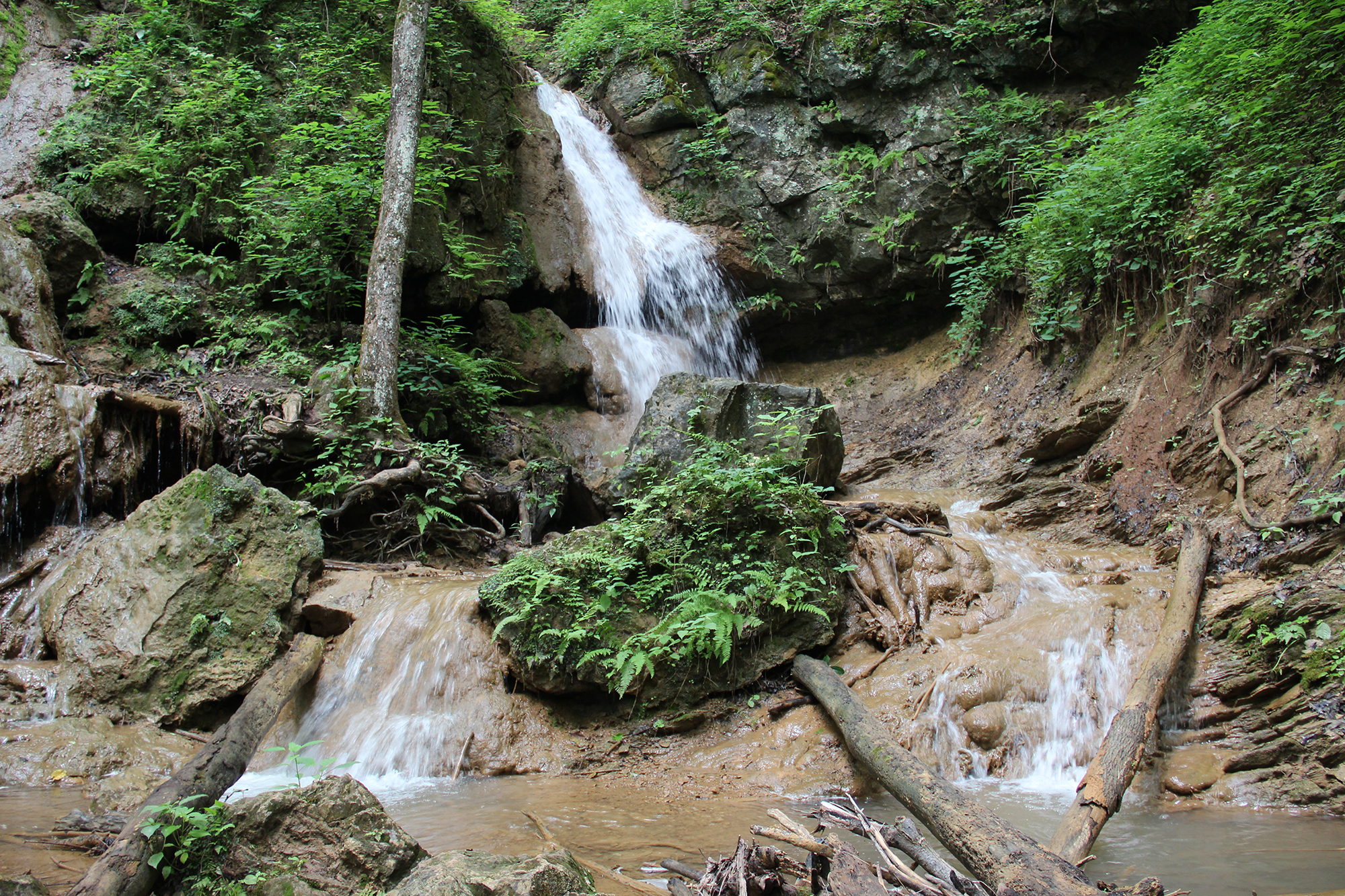
Part of a steep, rugged ridge that rises from the valley of the North Fork of the Roanoke River, Falls Ridge Preserve boasts a spring-fed travertine waterfall approximately 80 feet in height.
Salem Fault runs through the preserve, dividing it into two different rock types-Precambrian limestone and shale/sandstone. The corresponding difference in soil types generates a diversity of vegetation, particularly wildflowers and smaller flora.
The rocks in the travertine falls watershed grew steadily, as minerals and lime dissolved in the water precipitate upon them. Over thousands of years, the build-up of calcium carbonate steepened the stream's gradient and slowly created both the waterfall and one of the largest-known exposed travertine deposits. Large sinkholes on part of the land also indicate the existence of underlying caverns which have never been explored.
Montgomery County, southeast of Blacksburg
Open daily, dawn to dusk
655 acres
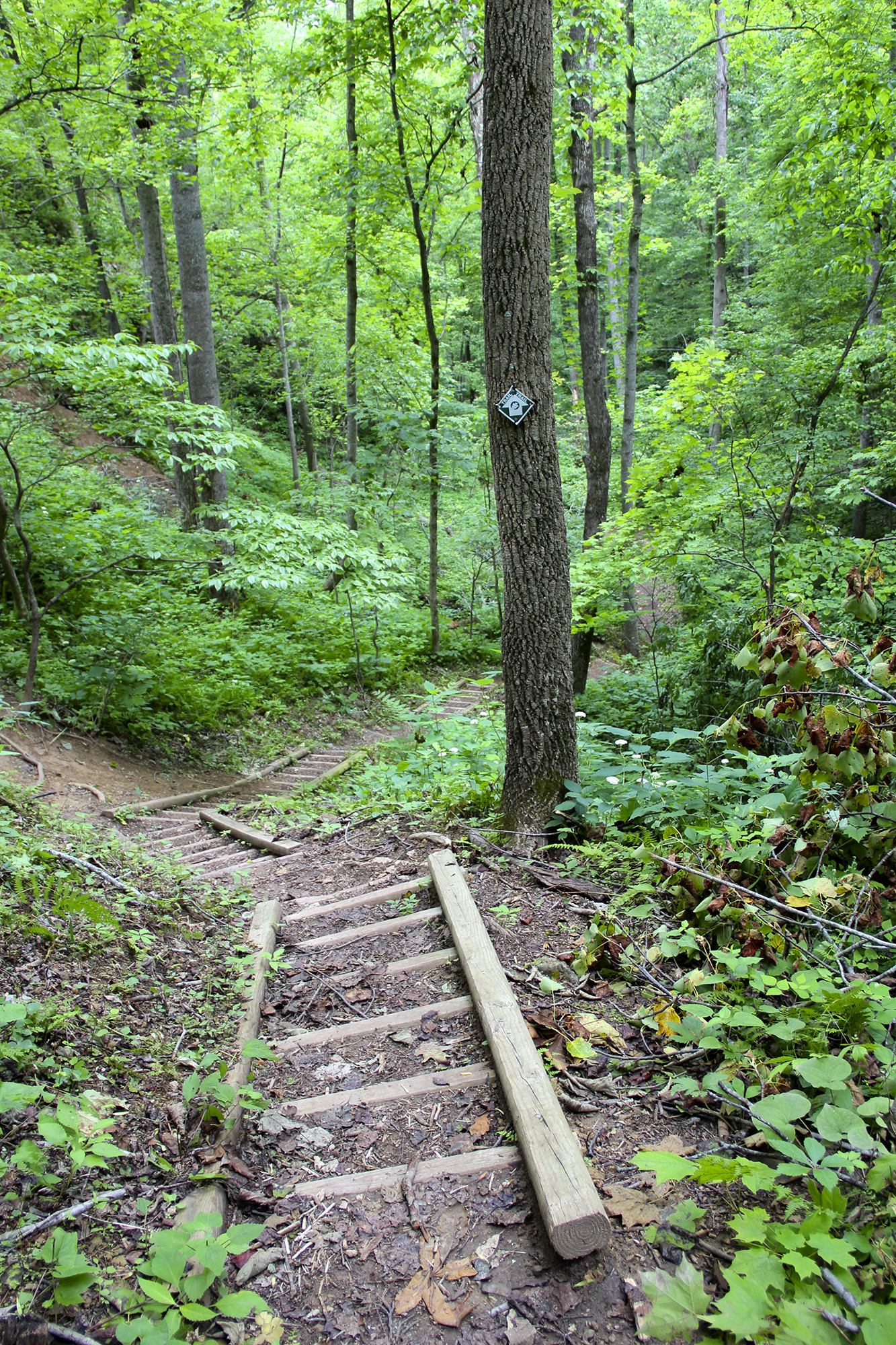
Easy hiking trails. Please stay on the trails to avoid harming sensitive habitat. Maps are available at the visitor kiosk.
In 1968, Mr. William P. Bradley, a photographer and publicist, bought the Falls Ridge Preserve area from a local family. Mr. Bradley used the property as a retirement home, eventually deeded Falls Ridge to the Conservancy in 1974.
A large Indian settlement was located upstream of Falls Ridge Preserve on the North Fork of the Roanoke River, but the only direct evidence of Indian activity has been the discovery of a few white flint arrowheads. In 1823, the Governor of Virginia granted to the Birchfield family 700 acres of land, encompassing part of the present day preserve. A local family, the Dudleys, later acquired the land and used it not only for farming but also to operate several enterprises: a wool carding mill, general store, post office, lumber milk gram mill and a livery. In 1939, a kiln to produce burnt lime was installed at the falls by Harry Dudley. Calcium carbonate cliffs (travertine) deposited by the stream were blasted loose, crushed and carted by mule to the top of the kiln. Traces of this operation can be seen near the falls.
The Conservancy has worked to upgrade the trails, providing good views of the waterfall while protecting nearby habitat from erosion. Rare plant species are being monitored.
Due to the tree cover, much wildlife flourishes here, including deer, raccoon, opossum, skunk, turkey, grouse, wildcats, ravens, great-horned owls, redtailed hawks, red-shouldered hawks and pileated woodpeckers. A very rare snail-the wild cherrystone snail-has also been found here.
Some of the plant species found here are very rare, such as the Allegheny plum and Goldenseal, and at least one species is endemic to Virginia: the Addison's Leatherflower. The woodlands primarily contain species common to an eastern deciduous forest. The uplands mostly consist of oak and hickory trees, with scattered ash, white pine, Virginia pine and pitch pine. In the ravines and hollows are tulip, poplar and hemlock. In the lowlands there is an abundance of American hornbeam. Sycamores are found near the streams.
Download a trail map of Falls Ridge Preserve (pdf, 272KB).
From Blacksburg:
From Christiansburg:
Have you been to this preserve? Are you thinking of visiting? See what others are saying about their experiences and add your comments below.
Time for you to join the discussion. Tell us about your experience at this preserve. What plants and animals did you see? When did you go? You can help others plan their visit when you share your thoughts. And thank you for visiting one of our nature preserves!
Whether scary or exciting, nature has a way of sneaking up on you. See stories
Hear some of nature's success stories and see how nature matters to us all. Watch videos
Brian van Eerden, Southern Rivers Program Director, with his daughter, Abigail, explore the pine savannahs at The Nature Conservancy's Piney Grove Preserve and adjoining International Paper property located in the Mid Atlantic Coastal Plain ecoregion of southeastern Virginia. © Mark Godfrey/TNC