

What Makes Peregrine Falcons Special?
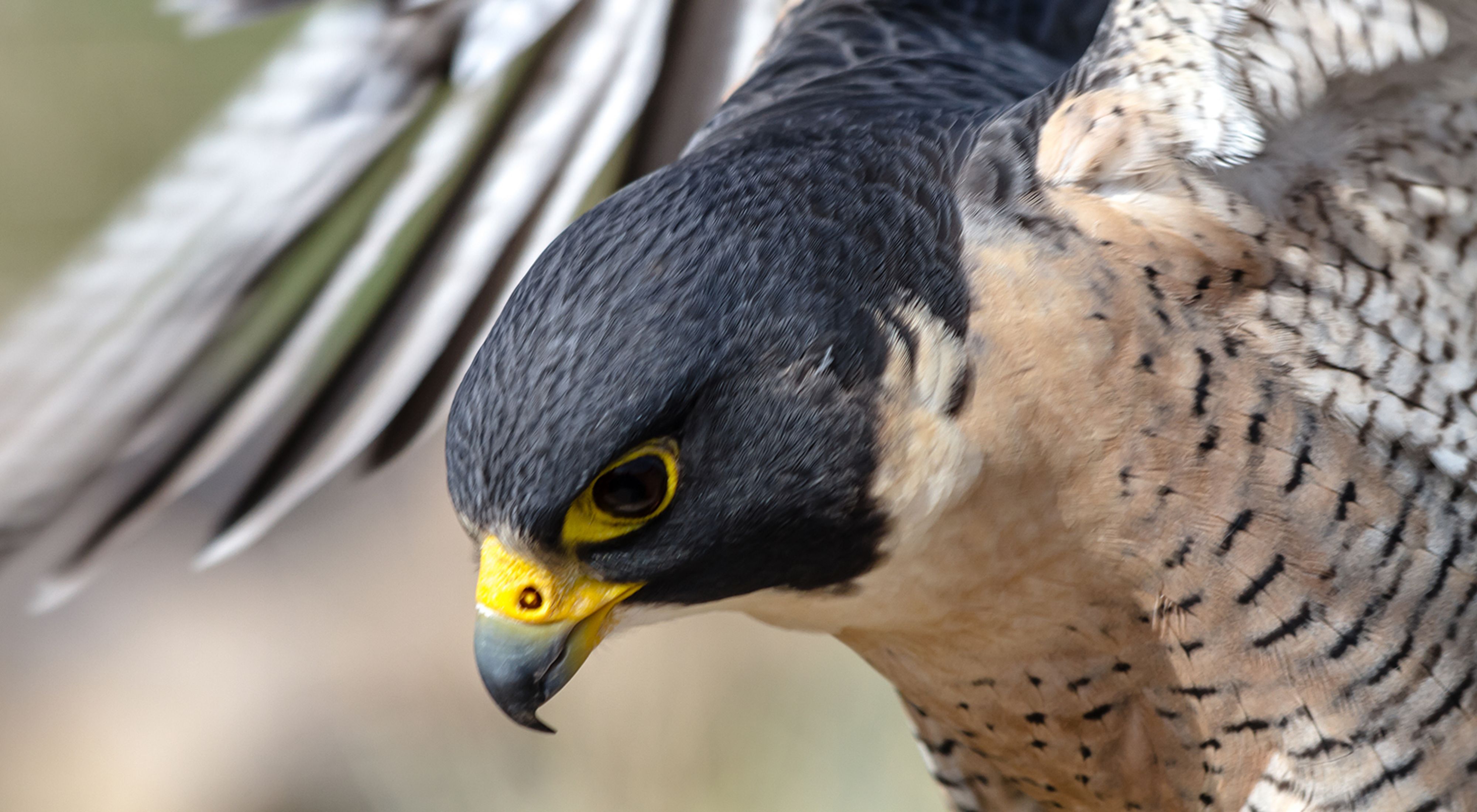
The American peregrine falcon is a stunning creature in flight. Its pointed, sleek wings have an average span of 40 inches. Its body and crown is a dark blue-grey with a contrasting white or buff underside marked with short, black bars. A mustache-like marking and a sharply hooked beak distinguish this elegant bird of prey.
The peregrine falcon is breathtakingly fast. In normal flight, it can reach an average speed of 40 mph and when in the chase, it can fly as fast as 65 mph. Even more impressive is when it's on the hunt; it can dive towards prey at speeds over 200 mph making it the fastest bird in the world.
Threats to the Peregrine Falcon
Peregrines are fast, aggressive creatures at the top of their food chain. While young peregrines are preyed upon by golden eagles and great horned owls, there are few threats to the adults other than humans.
By the mid-1960s, there were no peregrines in the eastern United States and by the mid-'70s western populations had declined by up to 90 percent. It was estimated that 3,875 nesting pairs were found in North America prior to the '40s, and by 1975, only 324 pairs existed in the US. Loss of habitat, shootings, egg collecting and other human disturbances had weakened North American populations for decades, but drastic declines didn't occur until after the widespread use of a popular insecticide—DDT. Like the canary in the coalmine, the peregrine falcon provided humans a warning as to how chemical pollution can disrupt the environment and the life around it.
DDT and Peregrine Falcon Population Decline
Dichlorodiphenyltrichloroethane, or DDT, came into wide use during World War II as an extremely effective pesticide. Its use continued after the war to control agricultural pests and malaria-carrying mosquitoes. Unfortunately, it took years for people to realize that DDT had adverse effects on a variety of ecologically important insects and birds and other animals. Bats, fireflies, bald eagles and peregrine falcons are just a few species that were badly affected.
DDT poisoning was especially harmful to birds like the peregrine falcon that sit at the top of the food chain. The poison accumulated in the peregrine's system after they consumed other birds that fed on seeds, insects and fish contaminated with DDT. High concentrations of a DDT metabolite called DDE prevented normal calcium production, causing thin, frail eggshells that would break under the weight of the parent during incubation. Many eggs did not hatch and the populations precipitously dropped until a mere 12 percent of the previous peregrine falcon populations remained in the United States.
Saved from the Brink of Extinction
In 1970, the American peregrine falcon was listed as endangered under the Endangered Species Conservation Act of 1969 (and it was listed again in 1973 when the Endangered Species Act passed). Encouraged by the EPA's banning of DDT in 1972, recovery projects began to take shape. Beginning in 1974, The Peregrine Fund, along with various national and state agencies in both the United States and Canada, embarked on a reintroduction program for the peregrine falcon.
Thanks to researchers at Cornell University, adult birds were successfully bred in captivity. After the eggs hatched, they were raised in the lab until they were three weeks old. They were then placed in hack sites (artificial nesting sites) where they were fed and cared for by unseen humans until their flight and hunting skills were developed enough for them to become independent. More than 6,000 American peregrine falcons have been released in North America since 1974 due to the cooperative efforts among federal and state Fish & Wildlife Services, The Peregrine Fund, Midwestern Peregrine Falcon Restoration Project and the Santa Cruz Predatory Bird Research Group.
The success of these recovery programs allowed the declassification of the peregrine falcon as a federally endangered species in 1999, although they remain federally protected under the Migratory Bird Treaty Act. The survival of the peregrine falcon marked the most dramatic success of the Endangered Species Act.

Did You Know?
- Peregrine comes from peregrin, meaning traveler in Latin. Quite a fitting name for a bird with one of the longest migrations in North America with some trips up to 15,550 miles roundtrip.
- Peregrine falcons are found all over the world with the exception of Antarctica.
- The female peregrine is known as the falcon while the male is called the tiercel. This is due to the fact that males tend to be a third smaller than the females, which is common in birds of prey.
- Pairs mate for life and will usually return to the same nesting site.
- Peregrine falcons do not build stick nests, but instead, scrape out depressions on high cliffs. However, they will use deserted stick nests of other species. Their nesting sites are called aeries or eyries.
- According to the Midwest Peregrine Society, 48 percent of peregrine nesting sites in the midwestern states are located on high-rise buildings and other tall structures.
- Falcons have a system of baffles in the nostrils to enable them to breathe during incredibly fast dives.
- Even though DDT has been banned in the U.S. since 1972, peregrine falcons migrate to other countries where it is still in use as a pesticide.
- DDT can take more than 15 years to break down in our environment. Fish consumption advisories are in effect for DDT in many waterways including the Great Lakes ecosystem.
American Peregrine Falcon Quick Facts
- Scientific name: Falco peregrinus anatum
- Size: 15 - 20 inches long
- Wingspan: 38 - 44 inches wide
- Weight: 1.25 - 2.75 pounds
- Plumage: dark blue-grey, black mustache mark, black bars on the chest, long pointed wings
- Nesting and habitat: varies; throughout the U.S., mostly on cliffs but also found in cities, using tall structures
- Behavior: forager, bird of prey
- Diet: carnivorous - other birds like songbirds and waterfowl; sometimes bats and small mammals
- Threats: larger birds of prey are known to eat young peregrines; humans