

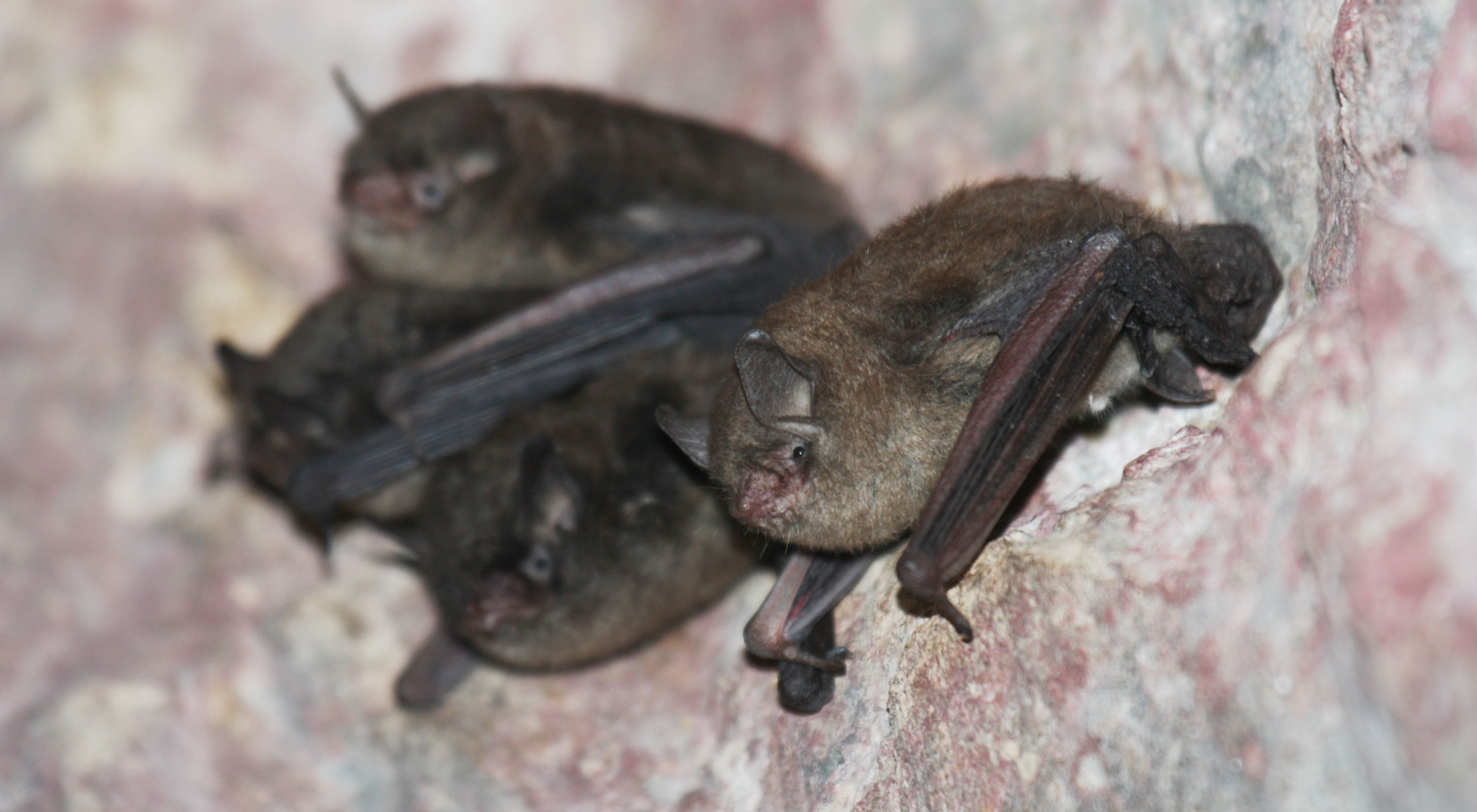
Indiana bats were first found in the Wyandotte Caves of southern Indiana, hence the name. However, it is their scientific name - Myotis sodalis - that describes these bats perfectly. Myotis means "mouse ears" which refers to the tiny, mouse-like ears that all bats in this genus share. The species name - sodalis - means "companion" in Latin, and refers to their highly social nature.
Indiana bats are also known as the social bat and for good reason. During hibernation, Indiana bats will cluster together in large groups in their hibernacula - caves in which bats hibernate. Huddling close together allows the bats to keep warm and muffles sound to limit any disturbances. Bat clusters also serve as an early warning system against predators. Bats outside of the mass can easily, and quickly, alert the other bats that danger is near.
Bat Conservation Bank of Indiana
Learn what TNC is doing in Indiana for bat habitat.
Check out the Bat Bank!Indiana bats were first found in the Wyandotte Caves of southern Indiana, hence the name. However, it is their scientific name - Myotis sodalis - that describes these bats perfectly. Myotis means "mouse ears" which refers to the tiny, mouse-like ears that all bats in this genus share. The species name - sodalis - means "companion" in Latin, and refers to their highly social nature.
Indiana bats are also known as the social bat and for good reason. During hibernation, Indiana bats will cluster together in large groups in their hibernacula - caves in which bats hibernate. Huddling close together allows the bats to keep warm and muffles sound to limit any disturbances. Bat clusters also serve as an early warning system against predators. Bats outside of the mass can easily, and quickly, alert the other bats that danger is near.
Where are the Indiana bats?
Indiana bats are not only found in caves nor do they only exist in the Hoosier state. Indiana bats can be found in most of eastern United States, though the largest populations are found in Indiana, Kentucky and Missouri.
The Indiana Chapter's Harrison County Glades and Twin Creek Valley nature preserve are home to Indiana bats. After hibernation, Indiana bats migrate to summer roosts, which are generally the edges of hardwood forests. Females tend to stay together, making homes with their pups under the loose bark of trees. There are some questions as to why males roost singly or in small groups and not with the females.
Threats to Indiana Bats
More than half of the bat species in the United States are in severe decline or listed as endangered. In addition to loss of habitat, one of the most dire threat comes from white-nose syndrome, a disease that has decimated bats in the U.S. and Canada.
As a federally endangered species since 1967, it goes without saying that the deaths of Indiana bats across the eastern United States have been the cause of much concern for conservationists and scientists alike for more than a decade. Called the white-nose syndrome, this disease has put the risk to the Indiana bat at an all-time high.
And it's not just Indiana bats, but several species of bats. An estimated 6.7 million bats have died since 2006 because of white-nose syndrome, a fast-moving disease that has wiped out entire colonies and left caves littered with the bones of dead bats.
What is The Nature Conservancy in Indiana doing for bats?
The Nature Conservancy has recently initiated the Bat Conservation Bank of Indiana (BCBI). The BCBI includes several sites that together protect two caves and 673 acres of surrounding habitat that are critical for the federally endangered Indiana bat and threatened northern long-eared bat. The heavy investment in renewable energy has made these banks more important as demand is expected to rise and bat habitats are disturbed for new utility scale projects across the state.
Interesting Facts about Bats
- The Indiana Bat is the only animal named for our great state.
- Bats are the only mammals that can fly.
- "Blind as a bat?" Not for these little guys. Bats have excellent eyesight perfect for long-distance homing.
- Bats also use echolocation to find their way around. By emitting calls then listening to the echoes of those calls, they can determine where various objects are located in the dark.
- Indiana bats tend to return to the same hibernacula every year. About 238,000 Indiana bats, approximately 46 percent of the total population, winter in Indiana caves.
- Hibernacula must be draft-free and maintain a stable temperature of under 50° F but above freezing for hibernation.
- Bats hibernate as a way of survival as there are no insects for them to eat during the winter months.
- Indiana bats are beneficial! Bats consume billions of insects every year and at no cost to the agriculture industry who could use the help. They are also great pollinators and spreaders of seeds.
More Bat Facts
- Scientific name: Myotis sodalis
- Length: 3 - 3.5 inches
- Wingspan: 9.5 - 10.5 inches
- Weight: 0.16 - 0.34 ounces
- Characteristics: varies from dark to light brown, sometimes a dullish gray; distinguished by pink lips
- Habitat: in winter - caves and mines; in warmer months - females and their young will roost under the bark of large trees; unclear where males go
- Range: the midwestern, southern and eastern parts of the United States; locations more limited in the winter than in the summer
- Diet: small insects
- Reproduction: breed once a year, in the fall; average of 1 pup a season; gestation lasts for 60 days
- Lifespan: average of 14 years
- Conservation status: federally and state endangered species; restricted to only a few caves; increasingly threatened by white-nose syndrome and habitat loss/conversion