

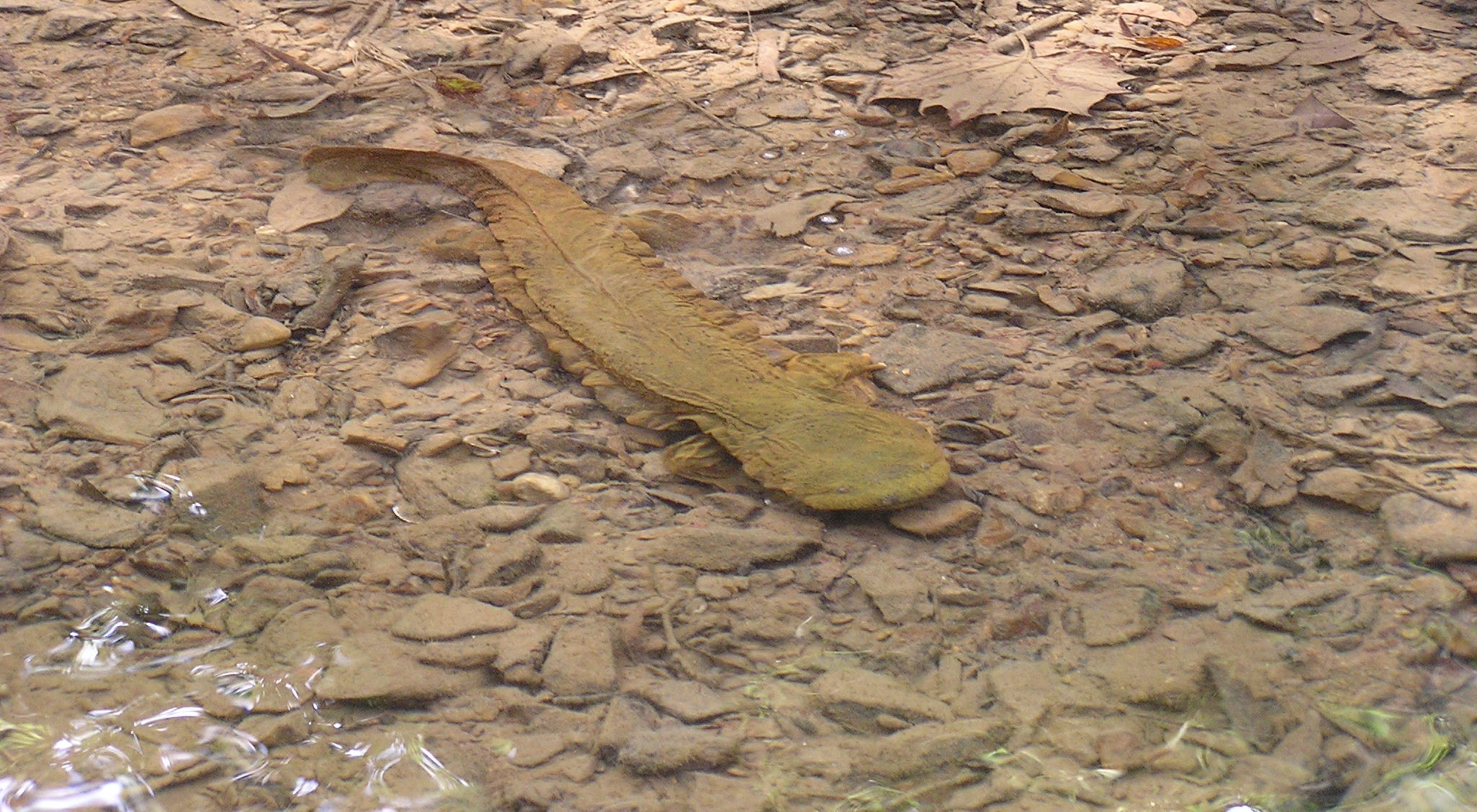
Hellbender Salamander
Despite its name, the hellbender is no hell-raising monster, but a harmless aquatic salamander.
Whether you call it a mud devil, devil dog, ground puppy, snot otter or Allegheny alligator, the Eastern hellbender salamander has the looks of “a creature from hell where it’s bent on returning.”
With a face only a mother could love, the hellbender needs our help. In Indiana, this salamander is now found only in the Blue River watershed. Hellbenders used to have a much larger range, occurring in most of southeast Indiana’s tributaries to the Ohio River. Its population has dropped drastically due to modification of stream habitats. These include the accumulation of silt, agricultural and industrial pollution, warming waters and the channelization and damming of streams and rivers.
Hellbender Discovery!
Big News from the Blue River
-

Researchers Discover Young Hellbender in Blue River
Biologists with the Indiana Department of Natural Resources and Purdue University recently documented a very young hellbender salamander in the Blue River. Read why this discovery is important
Hellbenders breathe through their skin and rely on cool, well-oxygenated, flowing water. One of their nicknames, “lasagna sides,” refers to the extra folds of skin they have to increase the surface area of their body for breathing. Dams stop swift water flow, resulting in warmer temperatures and lower oxygen levels.
Hellbenders play an important role in maintaining the river's ecology and are indicators of high-quality water. The lack of younger populations in locations where hellbenders live is becoming a growing concern.
How Big Do Hellbenders Get?
Hellbenders have been known to grow up to 29 inches long, though most will average about 12-15 inches. The hellbender has a broad flattened head, loose and wrinkled skin, small beady eyes and a paddle-like tail.
Are Hellbenders Dangerous?
Gentle and a bit shy, hellbenders prefer swimming in fast flowing river habitats and hiding under rocks during the day. They are mostly active right when the sun goes down when they search for a meal of crawfish.
Unfortunately, some people believe hellbenders are venomous. This has led to anglers killing them when caught on a line. Please help us dispel the myth that hellbenders are dangerous!
Threats to the Hellbender's Survival
Hellbenders are an endangered species in Indiana. Historical records indicate that the hellbender once occurred in Fourteen Mile Creek; Little Blue River; Whitewater River; Silver Creek; Indian Creek; the Ohio River and the Wabash River. Today, the hellbender's singular habitat in Indiana is the clean and clear Blue River of southern Indiana.
As a large but secretive amphibian, the adult hellbender's main threat is people. An angler using live bait may accidentally hook one. Then there are those who capture hellbenders to keep as pets or sell them to the pet industry. Taking this endangered species away from its natural habitat, for any reason, is illegal and detrimental to Indiana’s limited population.
Pollution also threatens this species. Hellbenders, like many other amphibians, breathe through their porous skin, which makes them extremely vulnerable to water pollution. That is why they are only found in water that is clear, clean and well-oxygenated with large rocks scattered on the bottom. Sedimentation can also fill in the spaces they occupy under large slabs of bedrock, which is why they have disappeared from many of their former river homes.

We Can’t Protect Hellbenders Without You
Sign up to receive monthly conservation news about your state chapter.
What is TNC Doing to Protect Hellbenders?
The Nature Conservancy is working with local partners and landowners to conserve the Blue River and save this unique amphibian before it's too late. One way we've done this is by planting more than half a million trees along the Blue River, creating a buffer that filters runoff and reduces erosion. The presence of trees and natural shrubs also shades the stream, keeping the water cooler and keeping oxygen levels high.
TNC is also partnering with local agricultural retailers to promote conservation practices on nearby farmland. These practices keep soil and fertilizer in place, improving water quality vital to the survival of hellbenders and other river dwellers.
TNC also worked with the City of Salem's wastewater treatment plant to use UV filtration of effluent as opposed to chlorine, which is harmful to humans and aquatic animals.
Removal of Dams in Southern Indiana
The Nature Conservancy helped to remove two low-head dams on Big Indian Creek in southern Indiana, and a third dam is slated for removal in 2024. With the third dam removal, more than 500 miles of historic stream habitat will be reopened to hellbenders. Removing the low-head dams increases habitat availability and allows hellbenders to move within the creek to find one another.
More Hellbender Work
Purdue University is promoting specific hellbender-friendly behaviors in a number of ways. Many of these projects are outlined at Help the Hellbender, which provides information on how anglers, homeowners, farmers and teachers can all lend a hand to help hellbenders.
Hellbender Facts
- Scientific name:Cryptobranchus alleganiensis
- Length: can grow up to 11-30 inches
- Weight: up to 4-5 lbs
- Coloration: varies; olive green, yellow brown or slate grey with black spots
- Diet: mostly crayfish but will also eat mollusks, small fish and worms
- Predators: large fish, turtles and other large water mammals such as river otters; man - when caught on fishing lines
- Lifespan: averages between 25-35 years in the wild; recorded up to 50 years in captivity
- Status: Remember, the hellbender is endangered in Indiana and must be protected. Under no circumstances should they be killed, trapped or kept as pets.

