

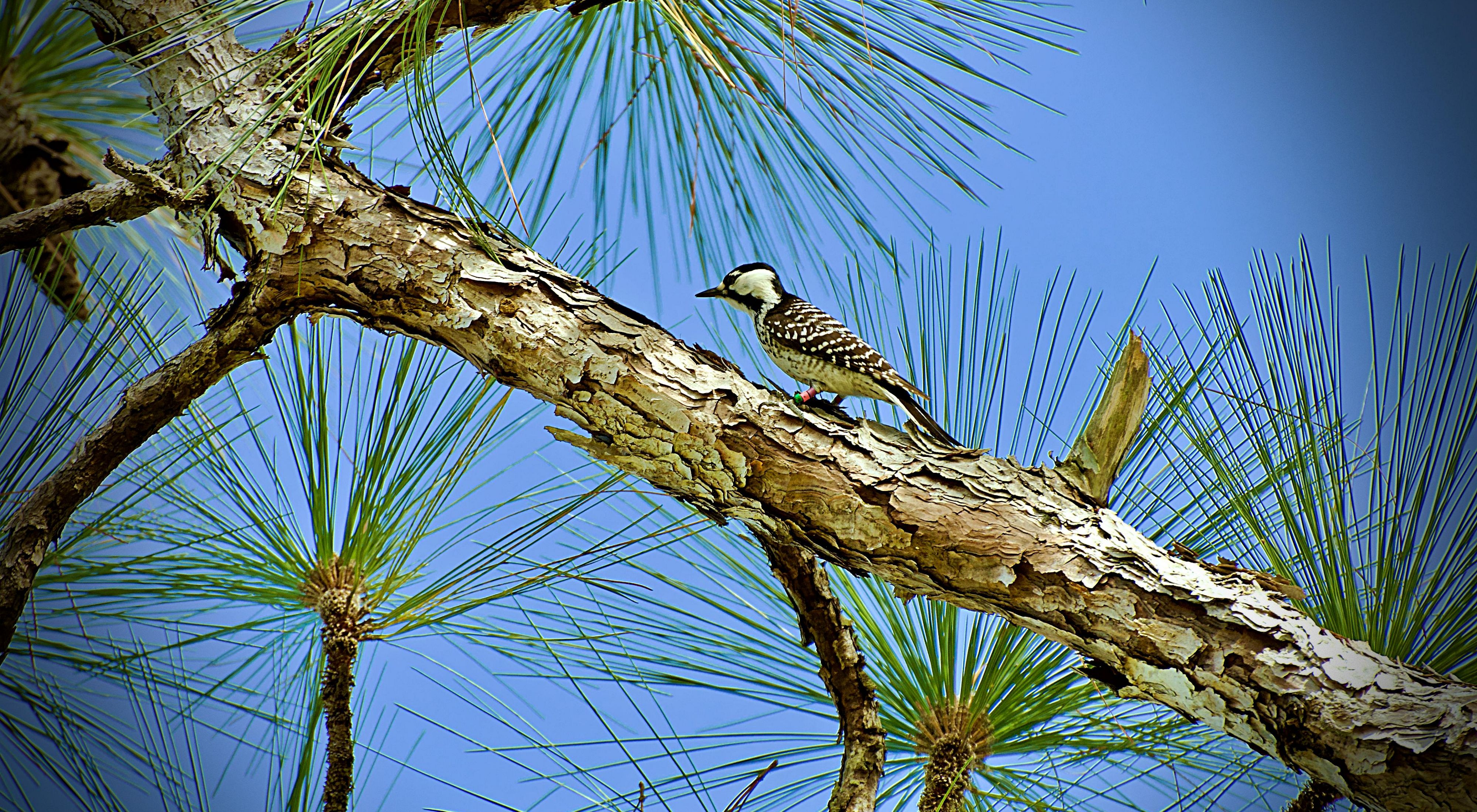
Reintroducing the Red-Cockaded Woodpecker in Florida
Once near extinction, red-cockaded woodpeckers are now breeding again at Disney Wilderness Preserve.
Back from the brink of extinction, a cherished species returns to Disney Wilderness Preserve. Once abundant throughout the pine forests of the southeastern U.S., the red-cockaded woodpecker had drastically declined with the loss of their pine habitat from clearing, logging, and conversion of land to agriculture. It is the only woodpecker in North America that makes nest cavities in living trees. But not just any tree: they only make cavities in live pine trees, with most of their diet consisting of insects living on the surface of the pines.
What Is a Keystone Species?
A keystone species is a species on which other species in an ecosystem largely depend. Every ecosystem has certain species that are critical to the survival of the other species in the system. Keystone species deliver tangible benefits to others in the ecosystem, necessary for other species to survive and thrive.
The red-cockaded woodpecker is a keystone species that provides a valuable service to its ecosystem by building tree cavities. A total of 27 other species have been documented using their tree cavities, including lizards, frogs, snakes, squirrels and other birds. The cavities provide shelter for the animals, and protection from fire.
The woodpeckers were extirpated, or locally extinct, at the preserve for decades, likely as a result of logging in the area throughout the mid-1900s. But thanks to 20 years of careful restoration and management of longleaf pine habitat, Disney Wilderness Preserve is able to support ten nesting pairs. The preserve's habitat is ideal for the birds with mature pine stands of pine trees (both longleaf and slash pine), trees of all ages, low and open groundcover vegetation and limited invasive species due to controlled burns conducted at regular intervals.


Red-Cockaded Woodpecker Translocation Program
To help save the species, U.S. Fish and Wildlife created a translocation program in 1998 to move red-cockaded woodpeckers from areas where they were abundant to areas with small populations but with room to grow, and to areas with suitable habitat but no birds.
The woodpeckers tend to mate for life in permanent territories, and their young often stay one or two years to help raise the next year’s chicks, a practice called cooperative breeding. Breeding pairs have been translocated to the preserve a total of eight times since 2007.
Translocations are performed in the fall and early winter in order to establish the populations and allow mating pairs to form before breeding season begins in the springtime. The translocation program follows strict federal guidelines. Young adult birds are carefully captured from healthy populations in Central and North Florida or South Carolina, and quickly transferred in boxes to the new site where they receive careful handling.
At night, biologists climb longleaf pine trees which have been prepared with man-made cavities. In the dark, they load the birds into the cavities. The nest hole is covered with a wire screen, with a drawstring leading down to the forest floor. At sunrise, all the cavities are simultaneously opened, allowing the birds to immediately see potential mates.


Red-Cockaded Woodpecker Reproduction and Lifecycle
In Florida, red-cockaded woodpecker breeding season lasts from April to July. A male and female share a territory, usually living in nearby tree cavities in the center of the territory.
The pair creates a nest high up in the cavity of an old-growth longleaf pine tree. It will be clear of foreign debris and full of wood chips on the inside. Sticky tree sap on the outside makes it snake-resistant. The female then lays a clutch of 2–4 eggs, usually one each morning, in a tree cavity the male built. The pair shares egg-sitting duty.
Emerging 11 days later, the hatchlings are featherless, blind and appear almost “raw.” Chicks remain in the nest for about 26 days, until they’re ready to fledge.
Both parents feed the chicks a variety of insects, all day long. Parents continue to feed their chicks even after they have fledged, for up to six months. Sometimes a fledgling from the previous year remains in the cluster to help the family.
In times of drought, bugs become harder to find. A typical “brood reduction” survival mechanism is for parents to feed only the healthiest chick. Typically, about two-thirds of the hatchlings survive.
Red-cockaded woodpeckers grow to about seven inches in length, with a wingspan of about 15 inches. The bird is named for a small red streak on each side of the black cap of the male only. It is noticeable on adult males only when they are agitated, such as when defending territory or fighting off a predator. Juvenile males display an obvious red patch, and this is used to determine the sex of a chick after about 12 days.


What Threats Do Red-Cockaded Woodpeckers Face?
- "Kleptoparasites” such as resident bluebirds, flying squirrels and owls, trying to steal their tree cavities.
- Rat snakes slithering into the nests, hungry for eggs and hatchlings.
- Drought and a shortage of bugs.
- Heavy rains with high winds that can flood cavities and lightning strikes which can kill the pine trees.
- Fire suppression, which leads to loss of pine trees.
Red-Cockaded Woodpecker Nest Monitoring at Disney Wilderness Preserve
After a successful translocation program, ten breeding pairs of elusive red-cockaded woodpeckers have now been established at Florida's Disney Wilderness Preserve. Staff check cavity trees for nests in each of territories where the birds thrive. Currently there are 11 active territories.
A small wireless camera called a “peeper” attached to a long telescoping pole is used to see inside the cavities, which are usually 10-30 feet high in a pine tree. Images from inside the cavity are viewed in a small handheld display. Nests are monitored weekly from April when breeding season begins until all chicks have fledged, usually by mid-June. After fledging, preserve nest monitors record the total population size by following the adults and fledglings after they emerge from their cavities at sunrise. This monitoring data is reported to U.S. Fish & Wildlife every year as part of the science work of TNC Florida's Center for Conservation Initiatives.


Visitors to Disney Wilderness Preserve may be lucky enough to catch a glimpse of the red-cockaded woodpeckers when hiking along the Red Trail. Preserve staff can pinpoint for visitors the exact location on the hiking trail map of the cavity trees marked by a distinctive white band.
Though the red-cockaded woodpecker's ideal habitat and population size has been been significantly reduced in the U.S., the bird's thriving populations and success of the translocation program at Disney Wilderness Preserve and other sites in Florida gives reason to hope for their long term survival. The population at the preserve may increase over time as our longleaf pine stands continue to mature, providing room for new territories for the red-cockaded woodpeckers to make their home at the preserve in the future.
Support Our Work
Help us continue our conservation work in Florida like ensuring habitat protection for the red-cockaded woodpecker.
Explore the Preserve

Restoring Fire to Florida’s Native Landscapes
With some Florida habitats needing regular intervals of fire, we carefully conduct controlled burns to safeguard the long-term survival of these places.

Wood Storks at Disney Wilderness Preserve
With the right nesting trees and forage, North America's only native storks are thriving at Disney Wilderness Preserve.

Longleaf Pine Forests—A Tree for Our Time
Throughout nine states in the U.S. southeast, TNC is working together to restore and manage longleaf pine forest from Texas to Virginia.