

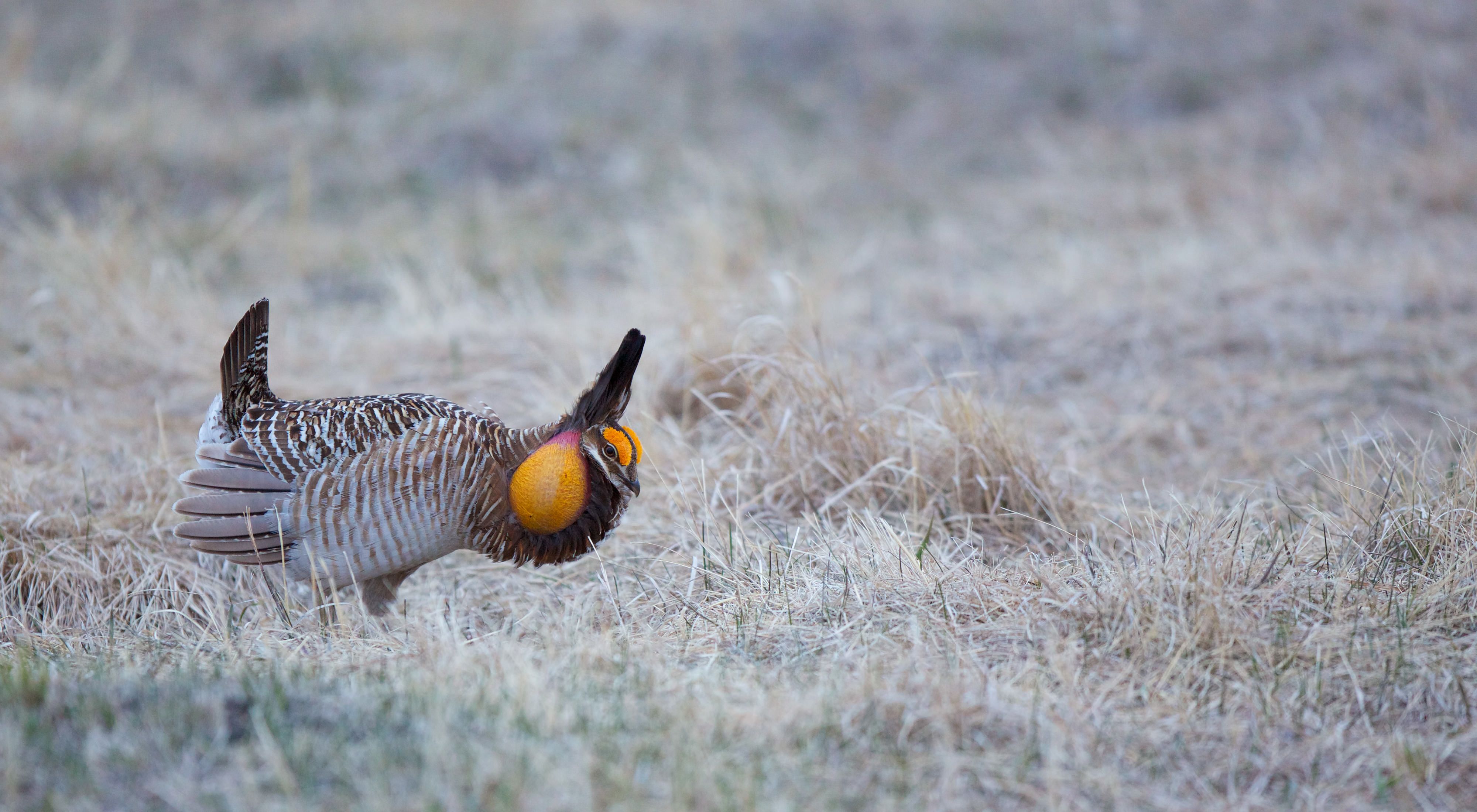
Greater Prairie Chicken
Best known for their elaborate mating rituals, the greater prairie chicken is no ordinary bird.
Meet the Greater Prairie Chicken
Once a common sight all over the Great Plains, the greater prairie chicken has experienced significant declines. Like its name, the greater prairie chicken is similar to a domesticated chicken in shape and size. Yet they look nothing like the common farm birds! Males have distinct, yellow eyebrows and brightly colored air sacs on their throats. Both males and females have bold brown and white striped feathers.
The "greater" in their name distinguishes them from the slightly smaller and lighter colored lesser prairie chicken.

Greater Prairie Chicken Facts
- Scientific name: Tympanuchus cupido
- Federal listing: Near Threatened
- Population: Estimated 360,000
- Ideal habitat: Tall and mixed grass prairies with cover for nesting
- Range: Small populations throughout the Great Plains from Canada to the Mexican Gulf Coast, as well as into the midwest.
- Nickname: Boomer
A Booming Courtship Display
Greater prairie chickens are best known for their elaborate mating rituals. Every spring, males gather together on traditional breeding grounds known as "leks" or "booming grounds" where each male defends a small territory.

First, he raises his pinnae feathers (long feathers on the neck) and tail feathers, inflates his bright orange throat sac, and lowers his wings. Then boom! The loud booming sounds made with their air sacs can be heard over a mile away.
Then, they rapidly stamp their feet and do a stylized dance by rotating in a half-circle one way, then the other way, and make runs at one another. Males often leap into the air to cackle and attack each other with their wings, feet, and beaks.
Even females get in on the action by chasing one another on the leks. Some "ancestral" leks have been used by the greater prairie chickens for more than a century. The best time to see these displays are just before and after sunrise in spring.
Females lay 7 to 17 eggs in nests hidden in tall, dense grass. They hatch after 23 to 26 days, and the female leads the hatchlings back to the leks to eat grass seeds and insects.

Females lay 7 to 17 eggs in nests hidden in tall, dense grass. They hatch after 23 to 26 days, and the female leads the hatchlings back to the leks to eat grass seeds and insects.
Why the Greater Prairie Chicken is Endangered
Greater prairie chickens have fared poorly due to grassland habitat being converted to other development uses. There are three subspecies of greater prairie chicken, each with radically different fates. The heath hen became extinct in 1932, Attwater’s prairie hen survives only in small portions of southeast Texas and is listed as Endangered in the U.S., and the greater prairie chicken, though threatened and isolated in much of its range, remains numerous enough to be hunted in four states.
Aside from habitat loss, the greater prairie chicken is also threatened by loss of genetic variance resulting from the isolation of populations with no natural corridors between groups. Most management focuses on habitat improvement, but population reintroduction may eventually be necessary to ensure genetic diversity. The largest remaining populations are in Kansas, Nebraska and South Dakota.

How We Protect the Greater Prairie Chicken
To help address habitat loss, The Nature Conservancy is restoring high-quality tallgrass prairie on the Great River Grasslands in Missouri. Here, TNC has a couple thousand acres, and we are working to aggressively restore it and convert land back to prairie using a diverse mix of locally produced seeds, as well as seeds harvested at Dunn Ranch Prairie.
TNC is also removing invasive woody vegetation and invasive species and purchasing lands bordering our high-quality prairies. The Conservancy puts conservation easements on these lands to ensure the area is only used for sustainable grazing, and the lands are put back on the open market.
Other Prairie Species

Sage Grouse
At one time the bird picked its way through sagebrush in 13 states and three Canadian provinces and numbered as many as 16 million. Today approximately 200,000 birds remain.

American Bison
Learn how The Nature Conservancy is protecting the once nearly extinct American bison across 12 preserves in the central United States.

Black-footed Ferret
Previously believed to have been extinct, a small population of black-footed ferrets were found in Wyoming in 1981. TNC has been working to restore their numbers ever since.