

Creating Hope for Nā Manu Nahele, Hawaiʻi’s Forest Birds
Hawaiʻi’s melodious and beautiful honeycreepers evolved with the Hawaiian Islands over millions of years, but we could lose them in our lifetime.
The Song of Our Forests: Hawaiian Honeycreepers
Hawai‘i’s melodious and beautiful honeycreepers evolved with the Hawaiian Islands over millions of years, and their song, image and significance are woven into the fabric of our islands’ culture. But we are losing them in our lifetime. Once, there were at least 142 species of native birds across Hawaiʻi, and more than 50 of them were honeycreepers. Today, only 17 honeycreepers remain. Eleven of those are endangered and four are at risk of extinction within the next ten years.
These birds play essential ecological roles in our forests as pollinators, insect eaters and seed dispersers. If we lose them, we lose the ecosystem roles they perform—and an irreplaceable piece of Hawaiian culture. However, there’s still time to protect these natural treasures and ensure their songs continue for future generations.
We must act now.
Discover how we’re using innovative technology and holistic forest management to create hope for Hawaiian forest birds.

Fewer Threats & More Healthy Forests
Hawaiian honeycreepers face a number of serious threats, including invasive mosquitoes that carry deadly diseases like avian malaria, as well as habitat loss and increasing temperatures. While our well-managed forest reserves provide birds with a home, as the climate warms, mosquitoes are moving to higher elevations and healthy, mosquito-free habitat is disappearing. In order for these birds to survive, they need safe, healthy native forests with fewer deadly mosquitoes.
TNC and our partners are working to help Hawaiian honeycreepers thrive by:

Championing an essential innovation to reduce mosquito populations
Scientists agree we must reduce mosquito populations as quickly as possible to stave off extinction. TNC co-led the development of an innovative mosquito suppression tool to do just that. With Birds, Not Mosquitoes, TNC and our partners are releasing non-biting, male southern house mosquitoes that cannot successfully reproduce. The first releases are taking place on Maui and Kaua‘i. There are no mosquitoes native to Hawaiʻi, and nothing living in Hawaiʻi depends on them for survival. Reducing or removing them will have no negative impact on Hawaiʻi’s ecosystem.

Caring for our native forests
Honeycreepers depend on healthy, thriving native forests for their only home. Our protection and restoration efforts across the islands ensure these birds have access to food and shelter and in turn nourish the forests through pollination. Our teams are also enhancing habitat and increasing food abundance at higher elevations, where birds can stay safe from the mosquitoes that carry avian malaria, by establishing new groves of nectar-producing native trees. We also conduct and support research to inform healthy bird conservation efforts, such as using song meters that record bird calls over time, providing population and range estimates.
These combined efforts, bringing together innovative new technology and holistic forest management, offer the best hope of saving Hawai‘i’s native forest birds. Working together, we can make a difference.
Meet the Birds
Celebrate and build pilina (relationships) with nā manu nahele. Click on each photo to learn more.

ʻIʻiwi, scarlet honeycreeper
Its long, curved beak evolved with native plants and is perfectly adapted to access nectar from tubular flowers like Hawaiian lobelioids. One of our most recognizable native honeycreepers, the ʻiʻiwi are highly susceptible to avian malaria from invasive mosquitos. Although listed as threatened, they are still relatively easy to see in some native forests on Maui and Hawaiʻi Island.

ʻĀkohekohe, crested honeycreeper
Using their exceptionally long legs, these magnificent, critically endangered birds often run across the treetops, foraging almost exclusively on nectar from ʻōhiʻa blossoms. Their calls are throaty and include buzzes, croaks and whistles. TNC’s Waikamoi Preserve on Maui is one of the only places they can still be found.

Kiwikiu, Maui parrotbill
This stocky, critically endangered honeycreeper uses its large parrotlike beak to split branches and small fruits in search of insect larvae, its primary prey. These birds mate for life, live up to 16 years and lay just one egg every year or two. Once found all over Maui and Molokaʻi, kiwikiu are now found only in places like TNC’s Waikamoi Preserve.

Maui ʻalauhio, Maui honeycreeper
This tiny energetic honeycreeper hops along tree trucks branches and twigs, flipping over bark and lichen in search of insects and grubs. They live in family groups and young birds help feed their younger nestlings. Although endangered ʻalauhio are still commonly seen in TNC’s Waikamoi Preserve.

ʻApapane, Hawaiian honeycreeper
ʻApapane are the most abundant native honeycreeper in Hawaiʻi , often gathering in pairs or flocks. They are an important pollinator for the ʻōhiʻa and feed on both nectar and insects, often in acrobatic positions. Although found only in high elevation forests, the ʻapapane is showing signs of developing tolerance or a slight resistance to avian malaria.
Make a Difference
Sign up to receive regular conservation updates from Hawai‘i.

A Model for Conservation
Connecting Hawaiian culture and tradition to conservation ecology
BirdNote®
Hawai‘i as a Model for Conservation
Written by Mark Bramhill
Mark Bramhill: This is BirdNote.
[Hawaiian forest soundscape]
Sam ‘Ohu Gon is the Senior Scientist and Cultural Advisor for the Nature Conservancy of Hawai‘i. And he‘s quick to tell you about how special Hawai‘i’s ecology is:
Sam ‘Ohu Gon: Hawai‘i is an amazing place because it‘s a microcosm of the world, right? In one limited area, you have a huge number of the major biome types of the entire globe. And you can find an environmental setting in Hawai‘i that can support just about every living plant species.
Mark Bramhill: With invasive species and climate change, Hawai‘i has experienced so much loss and extinction since Western colonizers arrived. But Sam believes Hawaiian culture and tradition are key to advancing conservation ecology, and has done a lot of work connecting these two worlds.
Sam ‘Ohu Gon: The best managed and preserved areas on earth that remain are ones that largely retain their indigenous relationships. It‘s a movement that‘s growing. And Hawai‘i is kind of leading the way in that. There is growing recognition that traditional knowledge is a vital part of long-term conservation success,
Mark Bramhill: Sam hopes that one day, Hawai‘i can be not just a microcosm of ecology, but of conservation as well.
Sam ‘Ohu Gon: We get to be the example of what can happen in a place if you can work the right combination of people and the natural world. People living in a place, caring for their lands from the top of the mountains above them all the way down into the depths of the sea.
Mark Bramhill: For BirdNote, I’m Mark Bramhill.
###
Senior Producer: John Kessler
Producer: Mark Bramhill
Managing Editor: Jazzi Johnson
Managing Producer: Conor Gearin
Content Director: Jonese Franklin
Bird sounds provided by The Macaulay Library of Natural Sounds at the Cornell Lab of Ornithology, Ithaca, New York.
Quiet Planet QP17-2106 recorded by Gordon Hempton.
BirdNote‘s theme was composed and played by Nancy Rumbel and John Kessler.
© 2024 BirdNote April 2024
Narrator: Mark Bramhill

Memory of the ‘Ō‘ū
One of the last encounters with a native Hawaiian bird.
BirdNote®
Memory of the ‘Ō‘ū
Written by Mark Bramhill
Mark Bramhill: This is BirdNote.
Like many native Hawaiian birds, the ‘Ō‘ū is presumed to be extinct. It was a stout, secretive yellow-and-green honeycreeper, seen for the last time in the late ’80s.
Sam ‘Ohu Gon was one of the last people to see an ‘Ō‘ū. He’s worked at The Nature Conservancy of Hawai‘i for nearly 40 years. And back in 1988, he took part in an Audubon Christmas Bird Count, hoping to encounter some of the critically endangered native birds.
Sam ʻOhu Gon: And my team and I had been listening and training ourselves, via tape recordings of various birds of that region to identify the calls of all of the endemic forest birds known from that place.
[Clips of Palila and ‘Ō‘ū are played, sounding like through a tape recorder]
Mark Bramhill: And so Sam and his group are dropped off deep in the native forests on the island of Hawai‘i.
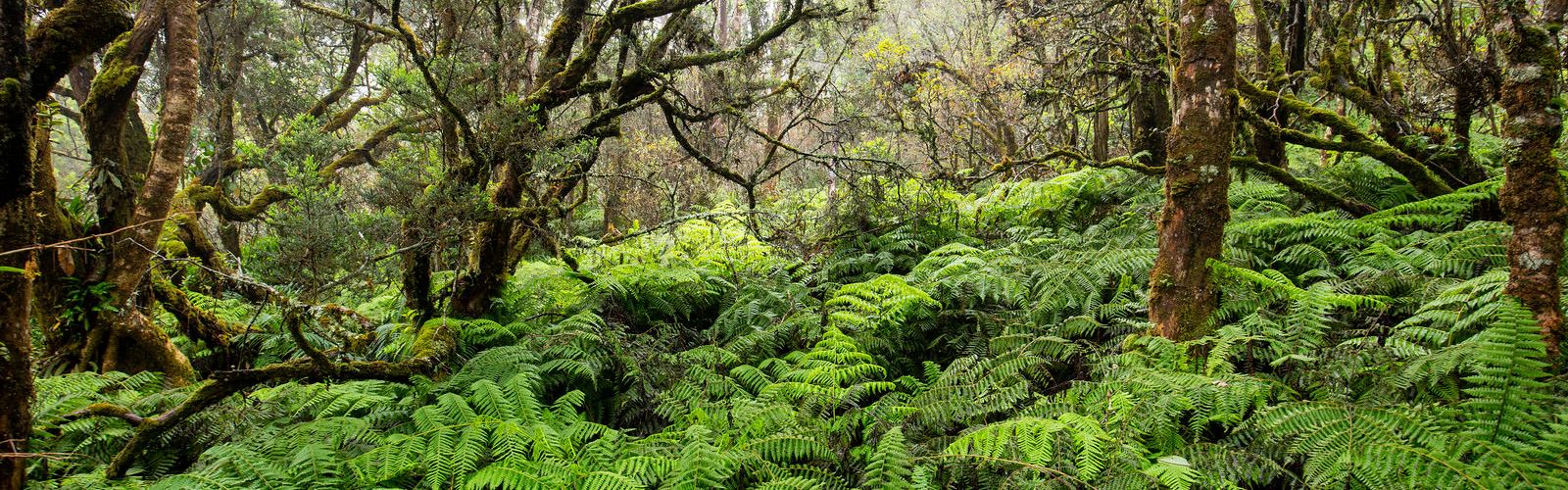
Sam ʻOhu Gon: I remember that day was a miserable, wet and cold day at elevations above 4,000 feet. And every 50 meters we would stop and listen for a certain amount of time, observe whatever birds, write them down. And I remember deep in the Hapu‘u, the native tree fern, section of that forest, and the Hapu‘u so thick there. And the fronds are very solid. You know, if they’re really dry, you can break through them. But they’re criss-crossing from all of the tree ferns growing in such density, and you’re trying to push through those old fronds that haven’t gotten soft enough yet. We were getting exhausted, and, uh, your senses tend to dull, um, when you’re miserable and cold and wet and exhausted in the middle of nowhere. And yet, we were stopped at one of those stations, and we heard that call…
[‘Ō‘ū singing]
Sam ʻOhu Gon: …and we looked at each other, and could hardly believe it, right? Did you hear that? You, you think that’s what we, what we heard. And, uh, we heard a call several times and then it was right above us. So we looked, took our binoculars up, but it was a tall forest and was drizzly and gray. And we were lucky enough to see a ghostly silhouette in the gray drizzle of an ‘Ō‘ū’s butt, essentially.
[‘Ō‘ū singing]
Sam ʻOhu Gon: We noted our location and on our return, we went to the lead ornithologist and asked to listen to the calls of the birds. And we told him, don’t tell us which birds we’re listening to. Just play the bird songs. And when we heard the call of the ‘Ō‘ū, we looked at each other, we asked him to stop. And we said, that’s exactly what we heard.
That was the first time and the last time that I had ever heard ‘Ō‘ū. It was a very hopeful feeling, but unfortunately, that was the last year that they were ever heard.
Mark Bramhill: The sense of loss feels personal to Sam—but he also feels a sense of honor in carrying the bird’s memory.
Sam ʻOhu Gon: To have seen plants and birds and animals that are just not to be seen, in common existence. That is a great privilege to me. I was so fortunate to be able to do that.
Mark Bramhill: The ‘Ō‘ū lives on, in stories, as the vibrant green in traditional Hawaiian featherwork. And people like Sam are working to ensure the remaining species, like the ‘I‘iwi, the ‘Apapane, and the Palila, stay with us.
[‘Ō‘ū singing]
For BirdNote, I’m Mark Bramhill.
###
Take Action for Nature
To learn about how you can help create hope for Nā Manu Nahele, Hawaiʻi’s Forest Birds, contact us.
You May Also Like

Helping Birds in Rhode Island and Beyond
What's happening with migratory birds, and how is TNC helping? Hear from master bird bander and Rhode Island associate state director, Scott Comings.

The Race to Save Native Forest Birds in Hawai‘i
Native birds in Hawai‘i are facing extinction due to mosquitoes carrying deadly avian malaria. Now, investments from the IRA and IIJA are supporting TNC's conservation efforts to restore populations.

Protecting Our Forests: Remember, you can make a difference
Anne Carter, Owner, Kulamanu Farm, Maui and Chair, Board of Trustees of The Nature Conservancy, Hawai‘i and Palmyra encourages conservation action in Hawaii.