

Dogs Come to the Rescue for Rare Salamanders
Sniffing out critical conservation data to help New Mexico's forests adapt to a changing climate.
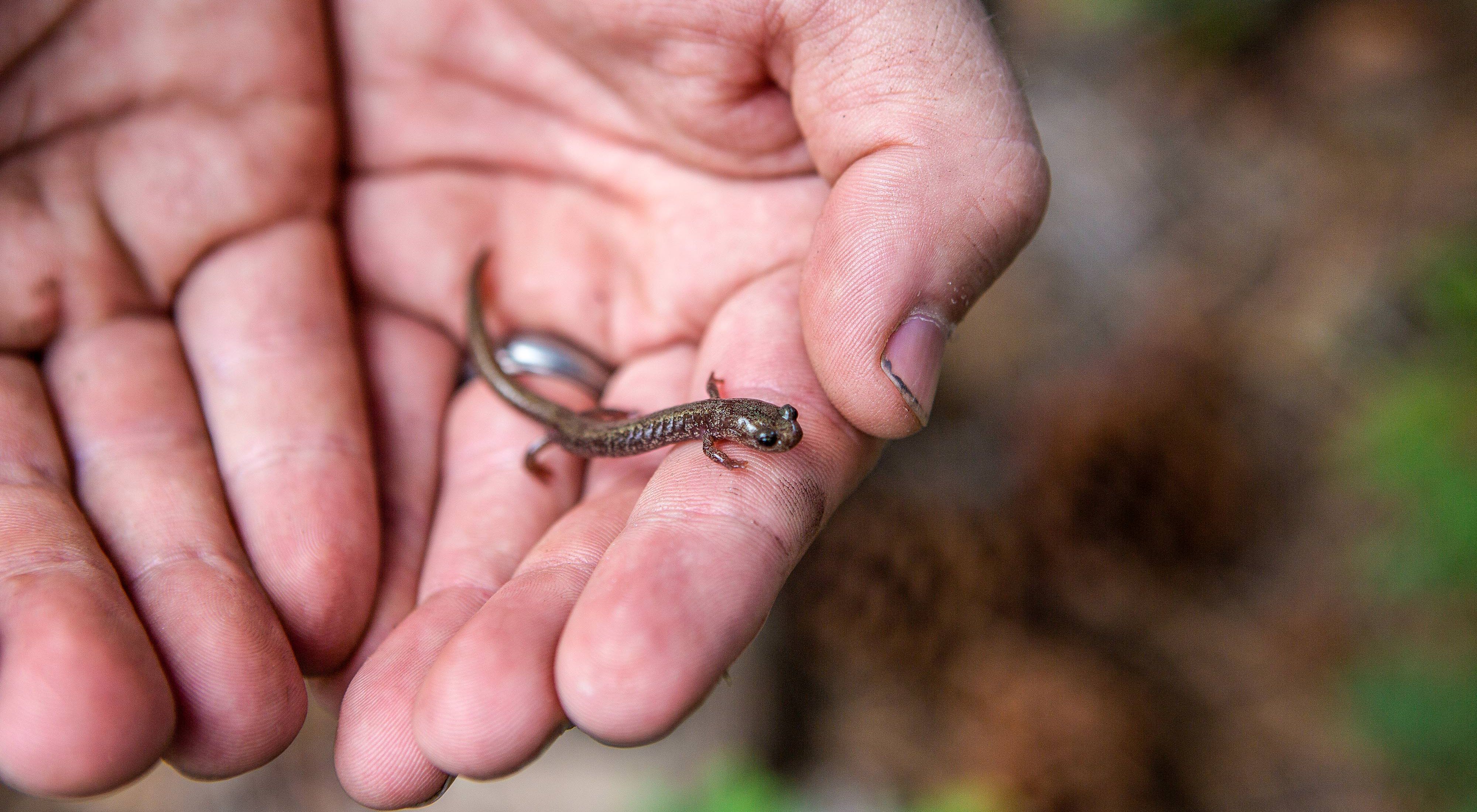
An unusual team of researchers was at work in New Mexico’s Jemez Mountains, helping protect a rare salamander found nowhere else in the world. These researchers are the four-legged variety—rescue dogs trained to sniff out wildlife and help conservation planners and land managers collect valuable data about wildlife populations.
The so-called Conservation Canines—all rescued shelter dogs—worked with the Conservancy, the US Forest Service, US Fish and Wildlife Service, New Mexico Department of Game and Fish, and the Valles Caldera National Preserve to map salamander distribution in the Jemez Mountains and improve our understanding of how to manage forests in the face of a changing climate.

Meet the Dogs
Frehly is a rescued border collie who quickly learned and excelled at locating wildlife in the field. He has sniffed out wolf, wolverine and grizzly, among others.
Sampson is a labrador rescued from the Seattle Humane Society. His field work has included research projects on lynx, northern spotted owls and sea turtle nests.
The Washington-based Conservation Canines team trains dogs to work happily and eagerly 4-6 hours a day, motivated by the expectation of a ball reward given only when they find wildlife scat.
The obsessive, high-energy personalities of scat-detection dogs make them difficult to maintain as family pets. For these dogs, a home placement could mean returning to the shelter and possible euthanasia.
Conservation Canines provides a rewarding and satisfying alternative—a career in the field of conservation research.
Dogs from the program have worked on projects searching for spotted owls in the Pacific Northwest, jaguars and wolves in Brazil, and even orcas in the Pacific Ocean.
Compared to traditional wildlife detection methods (remote cameras, radio-collars, hair snags and trapping), no other method can acquire such a vast amount of reliable information in so short a time. It’s an approach conservation planners and land managers find incredibly valuable.

The Search for Salamanders
Jemez Mountains salamanders—listed as endangered on the Endangered Species List in 2013 and found nowhere else on Earth except north-central New Mexico—are in rapid decline. A warmer, drier climate in the state has impacted the salamanders’ habitat, threatening their long-term survival.
They are also very hard to find. And that’s where the dogs helped.
The study was part of TNC’s effort to develop adaptation strategies that make the Jemez Mountains healthier and more resilient for salamanders, other animals and plants, and humans, too.
In 2011, TNC convened members of the Jemez Pueblo to collect salamander scent samples, which were then delivered to the Conservation Canines group for training.
Frehly and Sampson spent several weeks in the Jemez Mountains to continue their highly specialized training to locate the reclusive amphibians.
The dogs’ findings have helped TNC and partners better understand where salamanders live so we can move forward with our forest restoration program in the Jemez Mountains without impacting salamander habitat.
This forestry work will preserve wildlife habitat and improve forest health, reducing the risk of damaging wildfire.
Large and destructive crown fires—like the 2011 Las Conchas Fire—destroy the trees that the salamanders depend on for shelter, and are therefore the biggest threat to Jemez Mountain salamander populations.
Conservation Canines played a critical role in helping us develop strategies to keep New Mexico’s forests healthy for generations to come.